The Power that Flows Through Us
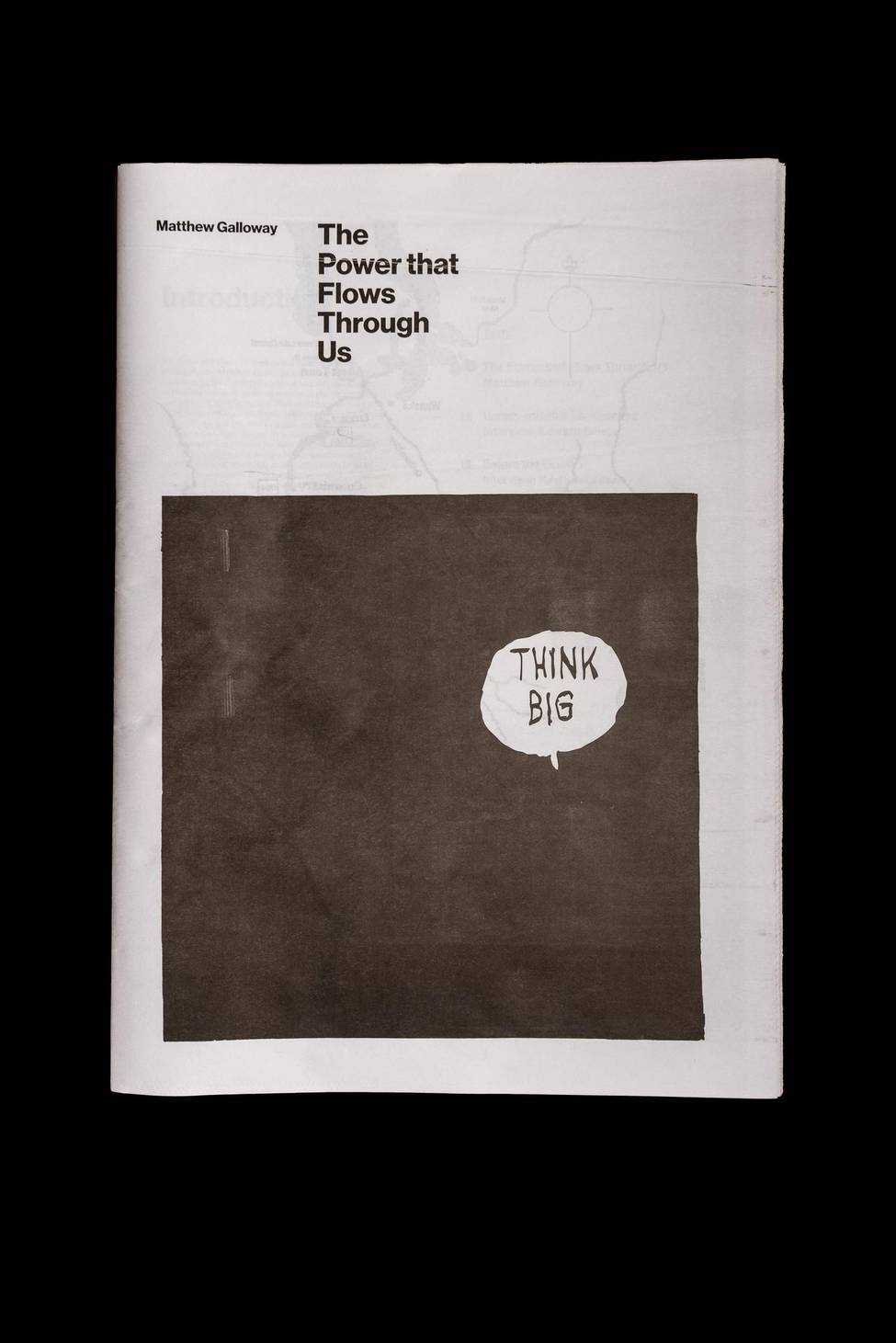
The Power that Flows Through Us is a multi-site public installation employing drone footage, sculpture, archival political cartoons and a newspaper, to examine the socio-political context of the construction and legacy of the Clyde Dam. With contributions from poet Brian Turner, writer Tina Ngata, and interviews with Edward Ellison, Kevin Jackson, Neil Gillespie and Duncan Faulkner, the project updates and continues discussions around Robert Muldoon’s Think Big initiative. This essay opens the newspaper published on the occasion of the installation.
At the official opening of the Clyde Dam on the 25th of April, 1994, security guards confiscated fruit from protestors standing on a viewing platform within throwing distance of Prime Minister Jim Bolger. Almost 30 years later, I stand on that same platform and imagine Bolger ceremonially cutting a ribbon, marking the end of the dam’s protracted, controversial construction; originally set in motion in the late 1970s as part of Prime Minister Robert Muldoon’s Think Big initiative.
Designed at the same time as the dam, the viewing platform is built from local schist I assume to be a by-product of the construction process. From the platform the structural presence of the dam plays with the senses, feeling at once miniature and dwarfing. The mass of concrete is eerily still, embedded in the landscape. The only movement comes from the water, flowing out from the structure, circling itself, before finally re-joining the flow of the Mata-au Clutha River.
Mata-au translates to “surface current,” a reference to the swirling nature of the river, the way it turns back on itself around obstacles in the water. As the water reorganises itself, I imagine it confused from its journey through the hydropower generators. As if the water is remembering how to be water again.
Above, power cables depart from the station, connecting to towers at intervals of a few hundred metres before disappearing over the hills.
At some point the electricity running through these cables will cross the Te Moana-o-Raukawa Cook Strait, arriving in the capital and lighting the halls of power. In 1982, Muldoon’s government—ignoring local concerns and a legal decision against the granting of water rights—passed the Clutha Development (Clyde Dam) Empowering Act. This Act set in motion the construction of the dam, in turn altering the course of the Mata-au and forming Lake Dunstan, an environmental intervention that submerged established horticultural land and half the Tīrua Cromwell township. In response, protesters padlocked the doors of the Court of Appeal in Pōneke Wellington and the High Court in Ōtautahi Christchurch. They also stuck a notice on the door of both courts that read, “This Court is now obsolete, irrelevant, and just a nuisance. Accordingly, it is CLOSED until such time as people no longer expect the law to protect their rights.”
I run my fingers over the safety rails on the viewing platform. Over the years passing travellers have used car keys to scratch their names into the faded orange paintwork, creating a rough texture. The crudely engraved names foreground the dam, like the presence of the public impressed onto the cold, utilitarian structures.
In archival footage from 1984 Muldoon speaks about his “much maligned ‘Think Big’ projects” in a grey suit against a bright blue backdrop. You can watch his micro expressions, the upturn in his left cheek as he half smiles and predicts the long-term economic benefits of ‘Think Big’. He talks of diversifying the New Zealand economy; of creating new primary processing industries and developing energy projects. In political cartoons from the time the same smirk can be seen drawn in Muldoon’s expression. In one, he smirks while depicted as a frog, imagining himself as a crowned prince, chanting “Think Big, Think Big, Think Big” to himself, willing the phrase into physical manifestation. In another he smirks filled with bullet holes, while bystanders joke that they like politicians to be transparent. In a third cartoon, Muldoon sits on the shores of the Mata-au poring over law books while dressed as a lifeguard. In the background figures representing Tīrua Cromwell call for help while drowning in promises.
From the viewing deck the surface of Lake Dunstan can be seen gently lapping against the edge of the dam, giving no hint the water is about to pass through the generator underneath. On the hills above large, step-like forms stabilise the slopes against the threat of landslides that were continually reported both during and after the construction of the dam.
After Muldoon and before Bolger, the fourth Labour Government enacted the Environment Act 1986. This established the Office of the Parliamentary Commissioner for the Environment, with powers to investigate any State decisions that might adversely affect the environment. Reflecting on this time in 2009 Labour Minister Michael Cullen told Radio New Zealand the dam represented “the single most monstrous environmental sin over the last 30 years.”
Throughout her first term as Prime Minister Jacinda Ardern often referenced the country’s hydropower network as a key reason Aotearoa is a world leader in renewable energy generation.
In 2020, as part of a proposed response to the economic downturn brought on by Covid-19, the Government proposed a new hydro dam at Lake Onslow in Central Otago, as a way to create jobs, promote industry and push Aotearoa toward a campaign promise of 100% renewable electricity generation by 2030. Multiple news outlets hailed the renewed push for such mega-projects as the second coming of Think Big.
In a 1982 issue of the National Business Review, a cartoon depicts pillars of the law being turned to rubble and then pushed into the Mata-au by a tractor-driving Muldoon, creating the dam. From the platform, I trace the path of the Mata-au away from the dam. I try to imagine the landscape as it once was—the structure dismantling, Lake Dunstan draining like a bath, exposing the long-submerged orchards, which in turn disappear back into the soil, the gorge and the riverbanks return, funnelling the surface current towards the ocean.
I turn back to face the structure; a mass of concrete warming in the Central Otago sun, the white-noise-drone of power generation ever present, and I wonder where we would be without it.